
October 13, 2026
From sampling to sharing: legal rules for marine biodiversity
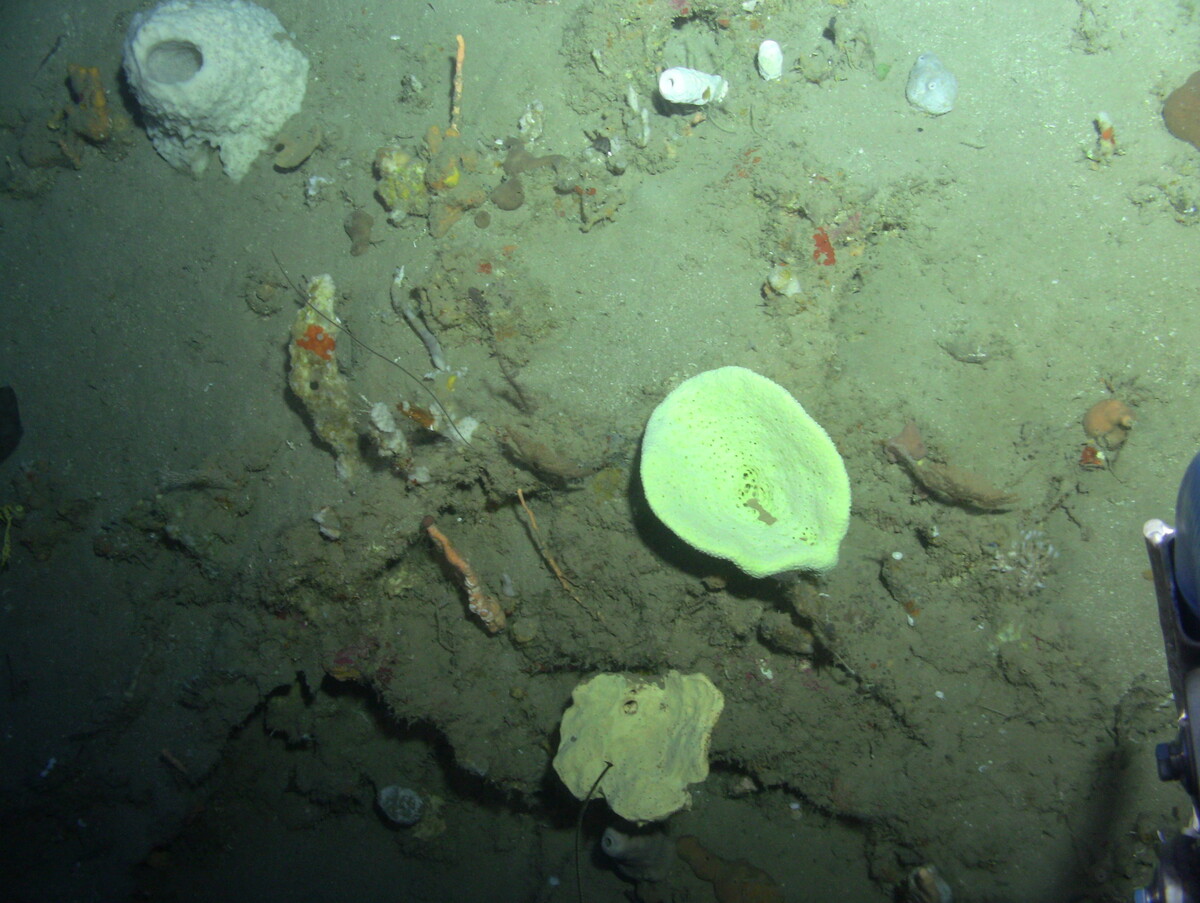
A sponge ground near Dominica at a depth of 100 m. Photo: Substation Curaçao. From Sipkema (2016), Microbial Biotechnology, doi:10.1111/1751-7915.12410 (CC BY 4.0).
Sponges are among the most primitive animal groups and may have been some of the first multicellular animals to appear on Earth. As usually happens in ancient groups, not all species live under the same conditions. While some sponges inhabit shallow water, where light and food are more accessible, others are less privileged. That is the case for deep-sea sponges, which live in the depths of the ocean, in darkness, cold and with scarce food supply.
At first glance, these conditions seem harsh, but the truth is that sponges are well-adapted to them. The secret behind how sponges have endured for millions of years is that they have not faced them alone.
A hidden network of life
Like their shallow-water counterparts, deep-sea sponges do not live in isolation but in close association with diverse microbial communities, particularly bacteria, archaea, and fungi. However, the composition and functions of these communities vary depending on the environmental conditions in which the sponge lives. While shallow-water sponges may benefit from photosynthetic microorganisms, deep-sea sponges harbour microbial partners adapted to darkness, high hydrostatic pressure, low temperatures, and limited food availability. Together, the sponge and its microorganisms form an integrated and dynamic ecological unit known as the holobiont.
Microorganisms support sponges in different ways, contributing to their resilience, resistance, health, and nutrition. This association may be particularly important in the deep sea, where microorganisms can help the sponge use scarce resources by recycling nutrients, transforming nitrogen, sulfur, and carbon compounds, contributing to metabolic homeostasis, and increasing their ability to cope with environmental stress. In this way, the microbiome may expand the sponge’s capacity to persist under challenging environmental conditions.
One of the most remarkable ways in which these microbial communities assist deep-sea sponges is through the production of secondary metabolites, which play an important role in chemical defense, communication, competition, and the regulation of interactions within the holobiont. These compounds may therefore support the overall persistence of deep-sea sponges. However, their direct role in tolerance to physical extremes, such as high hydrostatic pressure and low temperature, remains poorly understood.
Molecules serve as a chemical alliance
Sponges are one of the most chemically diverse sources of marine natural products. Although some of their secondary metabolites are produced by the sponge itself, others are synthesized by associated microorganisms. In many cases, the actual producer remains difficult to identify. These associations can expand the metabolic repertoire of the sponge holobiont and generate functions that may not be available to the host alone.
For example, some of these metabolic compounds behave as a chemical armory for the sponges. Polyketides are a clear case. These bioactive secondary metabolites are often produced by bacteria and fungi and have been found also in deep-sea sponges. They can help protect the sponge against predators, pathogens and surface colonizers. Although polyketides are not known to provide direct tolerance to physical extremes such as high hydrostatic pressure or low temperature, they illustrate how the combined metabolic capacities of the sponge and its microbial partners can enhance defense and contribute to the persistence of the holobiont in challenging deep-sea environments.
A collaboration beyond the surface
The cooperation between the sponge and its microbial partners does not remain confined to the depths of the ocean. It goes beyond the surface. Although their secondary metabolites do not directly protect the holobiont from physical extremes, they support biological interactions like defense, communication, and competition that enhance the holobiont’s overall resilience and persistence in the deep sea. For us, these molecules also hold strong industrial promises.
Their bioactive properties make them valuable leads for pharmaceuticals, green biotechnologies, and other high-value bio-based applications. Returning to polyketides, the focus is on industrial potential. Due to their cytotoxic activity, they could support the development of anticancer drugs in the pharmaceutical industry. They may also hold value for agriculture, as their protective properties could inspire new approaches to crop pest control and support more efficient food production.
Thanks to this microbial cooperation, deep-sea sponges have been able to survive for millions of years in the deep sea. More than that, this collaboration has gone beyond the depths, also contributing to the industrial development of our society. It shows that cooperation often achieves what isolated systems cannot and reminds us that working together is often the key to resilience, adaptation, and progress.
